All you need to know about the emblematic lakeside villages
Scattered around the shores of the Prespa Lakes, the villages of Prespa have preserved their distinctive character. Stone-built houses, wooden details, tiled roofs, flower-filled courtyards, and the scent of wood-burning fireplaces create a warm and welcoming atmosphere from the moment you arrive.
One of the greatest joys of travelling in Prespa is getting to know its small settlements and the warm hospitality of their people. These gem-like villages stand out for their simple, unpretentious charm, where time seems to move at an unhurried pace. Visit them and listen as each one quietly tells its own small story, together forming the larger narrative of the region.
Among them, Psarades stands out as one of the most beautiful villages in the country and the only Greek settlement on Great Prespa Lake. Designated as a traditional settlement, it is distinguished by its stone-built houses and its unique views over the lake, while also serving as the departure point for boat trips that lead across the waters to the rock paintings and hermitages of Great Prespa.
As your journey through the Prespa region continues, Agios Germanos emerges as one of the finest examples of a traditional village. Wandering through its stone-paved streets, you come across restored mansions before reaching the Byzantine church of Agios Germanos, one of the area’s most important monuments. Just a little further on, the traditional watermill—the only one that survives out of the twenty that once existed in the region—still stands as a living reminder of everyday life in earlier times. The experience is further enriched by the village’s Byzantine Collection, which brings together important finds from the wider area, while the surrounding green landscape completes a setting where history, tradition, and tranquillity come together.
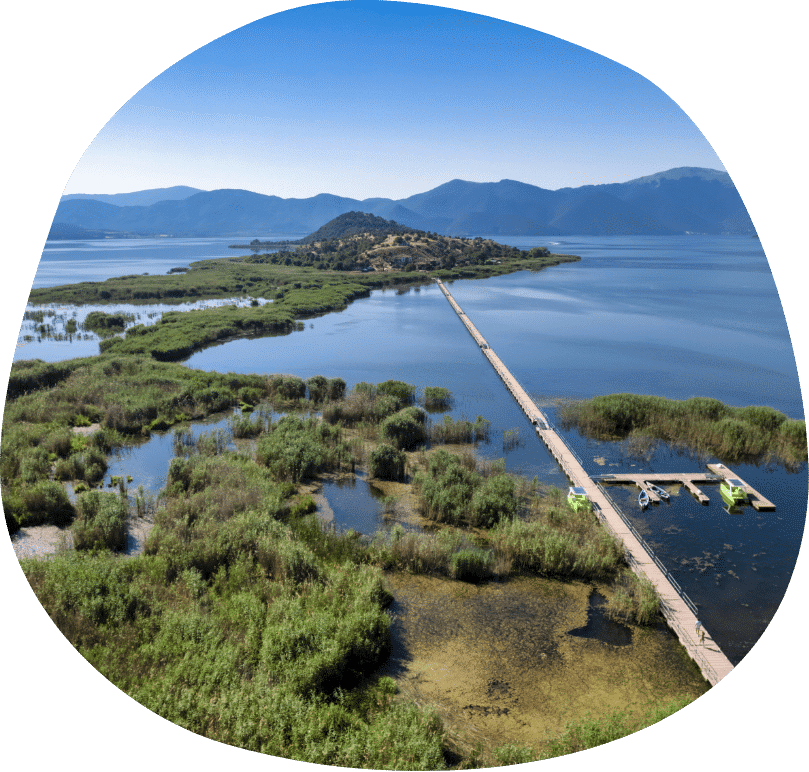
A distinctive highlight of Prespa’s landscape is Agios Achilleios, the small inhabited island in Small Prespa Lake, connected to the opposite shore by a 630-metre pedestrian bridge. Set within a landscape of wetlands, reed beds, and complete tranquillity, it offers a unique sense of stillness and isolation. Within this unique setting, you can explore the ruins of the 10th-century Byzantine basilica dedicated to Agios Achilleios, as well as the 15th-century Monastery of Panagia Porfyra, both standing as powerful reminders of the island’s long history. If you pause here for a coffee or a meal, you may even catch sight of herons moving quietly through the lake’s shallow waters, reinforcing the sense of calm, while a walk among the few stone houses of Agios Achilleios, with open views across the lake, completes the experience, leaving a lasting impression that stays with you long after your visit. Other villages worth including in your Prespa route are Antartiko, once a main village with impressive brick-built mansions, the village of Kottas, known for the important house-museum of Captain Kottas, and Laimos, the administrative centre of the Prespa municipality, which also hosts key local services and infrastructure.
Municipality of Prespa
Where the lakes become history and a sanctuary for life
Two lakes, one inhabited islet, 16 villages, and countless natural landscapes come together to form the captivating mosaic of Prespa—a destination that truly deserves a place among the journeys of a lifetime. And that is no exaggeration.
In the northwestern corner of Greece, where three countries meet around two lakes, lies the Municipality of Prespa—a place of rare charm that captivates with its quiet, almost poetic beauty. Every moment of the journey here feels rewarding. You may watch majestic Dalmatian pelicans soaring above Small Prespa, discover solitary hermitages clinging to the cliffs of Great Prespa overlooking the Tri-Border point where the waters of Greece, Albania, and North Macedonia meet, or see the traditional plaves—Prespa’s distinctive wooden boats—gliding gently across the lakes. Here, every step brings you closer to the region’s rich heritage. You will discover villages such as Agios Germanos, Antartiko, and Kottas, stand before remarkable Byzantine frescoes, and pause to admire sweeping lake views that seem to stretch endlessly before you. Welcome to a place where history, culture, and wildlife are woven together into an unforgettable travel experience—one where you become part of the story.
Two lakes, one world
In Great and Small Prespa, you will experience one of the most important wetlands of international significance, home to more than half of Greece’s bird, mammal, and amphibian species. Small Prespa is also home to the world’s largest colony of Dalmatian pelicans, while in the grazing lands of Psarades and Agios Achilleios you may come across the indigenous miniature cattle, a rare and protected species, moving freely across the pastures.
Together with the surrounding area, the two lakes form one of Europe’s most important ecosystems, where wet meadows, reed beds, rocky shores, and forests of ancient junipers (cedars) create a landscape of extraordinary natural richness—waiting to be explored and experienced.
An entire monastic world carved into the rocks
Boat routes take you across Great Prespa to its hermitages and rock paintings: small chapels carved into the cliffside, centuries-old frescoes, and stories of ascetic life that seem to echo through the stone silence of the caves. These hermitages, abandoned at the end of the 15th century when the monks moved to Mount Athos, can still be visited today on organised boat trips departing from the village of Psarades.
Outdoor adventures that elevate the journey
Hiking through enchanting forests and lakeside trails, cycling, boating, kayaking in the almost always calm waters of the lakes—and paragliding over Prespa National Park for the more adventurous—are just some of the activities that make every season in Prespa a true lifetime experience. In winter, the experience extends even further to the nearby Vigla–Pisoderi ski centre, where you can test your skills on the snow.
A taste of Prespa
Prespa’s culinary enchantment lies in its simplicity—and it is deeply rooted in the land. The famous Prespa beans, a PGI-certified product, take centre stage at every table, alongside baked or fried carp and tsironia, small fish that are dried and served as a refined meze for tsipouro. Handmade pies with greens or peppers also stand out, as does the so-called “Prespa caviar”—a spread made from roasted Florina peppers—perfect to take home along with other local products.
Lakes that reflect centuries of history
Do not look for the history of Prespa only in the books of yesterday. It is present in every stone, every shoreline, and every path you walk. From the Neolithic period to the turbulent decades of the 20th century, this land carries millennia of memory, revealing a past that still echoes through its history today.
Human presence here dates back to the Neolithic period (around 7000 BC) and continues through traces of the Bronze and Iron Ages. On Agios Achilleios, architectural remains and inscriptions from the Hellenistic and Roman periods have been uncovered. In antiquity, the lakes were known as Mikri and Megali Vrygiis, and from the 5th century BC they formed part of the Macedonian kingdom before later becoming part of the Roman province of Illyricum.
At the end of the 10th century, Tsar Samuel made Prespa the centre of his power, transferring the relics of Saint Achilleios from Larissa and building the great basilica on the island that bears his name. Emperor Basil II later restored Byzantine rule and, according to sources, constructed two fortresses, ‘Vasilida’ and ‘Konstantion’. The 14th century saw Serbian rule, which ended in 1395 when the area came under Ottoman control. During this period, monastic life flourished: hermitages, churches, monasteries, and retreats formed a unique mosaic of faith and art that survives to this day.
From the mid-19th century onwards, Prespa became a key setting of the Macedonian Struggle, with figures such as Captain Kottas from Roulia (today’s Kottas), the Dalipis brothers from Sfika, Pavlos Kyrou from Antartiko, and Lazos Tsamis from Pisoderi playing leading roles. Pisoderi was also the birthplace of Nikolaos Kasomoulis, a Macedonian fighter of the Greek War of Independence and historian who recorded the Siege and Exodus of Messolonghi, as well as the struggles and death of Karaiskakis.
Liberation came in November 1912, while during the First World War the region became an active theatre of conflict. In the Second World War, the counteroffensive launched from Krystallopigi led to the capture of Korçë on 22 November 1940. The Greek Civil War that followed left deep scars, with cave shelters, guerrilla hospitals, and villages gradually being abandoned. From a population of around 7,000 before the war, only about 1,500 remained in the area by 1951. The arrival of Vlach pastoral communities in 1953 brought some demographic recovery, though it did not reverse the overall decline. Today, Prespa remains the most sparsely populated municipality in Greece—a place where centuries of history coexist with an extraordinary natural environment, creating a destination unlike any other.
Prespa is a place that lives and breathes nature. Here, you don’t simply observe the landscape—you experience it. If you are keen on outdoor adventures, you can choose between the mountains, the lakes, and the open sky, with activities suited to every season and every mood.
Boat tours to the hermitages
Psarades serves as the gateway to one of Prespa’s most memorable experiences: a boat tour across Great Prespa. Aboard small...
Psarades serves as the gateway to one of Prespa’s most memorable experiences: a boat tour across Great Prespa. Aboard small wooden boats departing daily from the village’s harbour, you will explore the lake’s waters and learn about its history and natural richness. As you approach the cliffs, you will discover hermitages and Byzantine rock paintings that tell stories of centuries of monastic life and devotion. As the boat glides quietly across the water, time seems to stand still, and the landscape transforms into a profound spiritual and immersive experience—one of the most beautiful you can enjoy in Prespa.
Hiking and cycling
Prespa is made for exploration: on foot or by bicycle, every route brings you closer to its nature, its villages,...
Prespa is made for exploration: on foot or by bicycle, every route brings you closer to its nature, its villages, and its lakes. The trails pass through forests, lakeside areas, and historic settlements, offering striking changes of scenery and a deep, almost dreamlike sense of tranquillity. From short walks around Small Prespa to more demanding mountain routes, hiking here offers an authentic encounter with the landscape and its rhythms. If you prefer two wheels, cycling between Great and Small Prespa reveals unforgettable views: gentle routes ideal for families, as well as more challenging paths for experienced cyclists, always framed by water, birdlife, and a sense of absolute freedom.
Kayaking on the lakes
Paddle across the calm waters of the lakes and discover the area from an entirely different perspective. Glide past reed...
Paddle across the calm waters of the lakes and discover the area from an entirely different perspective. Glide past reed beds, rocky shores, and small secluded beaches, observing rare bird species up close. Whether you are a beginner or an experienced paddler, kayaking is one of the best ways to experience the serenity of the landscape.
Birdwatching
A true paradise for all birdwatchers, the Prespa wetlands are internationally renowned—among other reasons—for hosting the world’s largest colony of...
A true paradise for all birdwatchers, the Prespa wetlands are internationally renowned—among other reasons—for hosting the world’s largest colony of Dalmatian pelicans. Bring your binoculars and explore the shores to spot herons, cormorants, and countless waterbird species. Here, birdwatching is not just an activity; it is an immersive encounter with a living ecosystem.
Winter sports
Are you a snow lover? Just a few kilometres from Prespa, on the road to Florina, the Vigla–Pisoderi Ski Centre...
Are you a snow lover? Just a few kilometres from Prespa, on the road to Florina, the Vigla–Pisoderi Ski Centre awaits with slopes for all levels of skiing and snowboarding, set in one of the most beautiful natural landscapes in Greece. The views towards the surrounding mountain peaks are breathtaking, and as the sun sets, the area transforms into the perfect setting for a warm drink and relaxation.
Paragliding
If you want to see Prespa from above, brace yourself for a wild ride. Paragliding in Prespa is a once-in-a-lifetime...
If you want to see Prespa from above, brace yourself for a wild ride. Paragliding in Prespa is a once-in-a-lifetime experience: flying alongside pelicans, with the lakes and mountains below spreading out like a painting. Launching over Prespa National Park, you will surrender to the wind and take in views that will take your breath away. The silence of the wind, the vast blue-green panorama, and the feeling of absolute freedom create an experience that will stay with you forever—a tribute to nature and alternative exploration.
A journey into the flavours of Prespa
Prespa’s gastronomy is an integral part of the region’s identity—simple, earthy, and generous. Here, food is a way of life, closely connected to the seasons, the land, and the waters of the lakes. The region’s recipes were born in modest homes, yet rich in imagination.
The Prespa bean, a Protected Geographical Indication (PGI) product, is the undisputed star of the local cuisine, prepared either as a traditional bean soup or baked in the oven with tomato and herbs. From the lakes come the carp, traditionally cooked fried or baked, as well as the tsironia, small fish that are dried and served as a meze alongside local wine or tsipouro. Alongside these flavours, the famous ‘Prespa caviar’ stands out—a spicy spread made from roasted Florina peppers, olive oil, and herbs, simple yet irresistible. Meat dishes made from locally raised cattle also form an integral part of Prespa’s culinary identity, valued for their pure, natural flavour and traditionally slow-cooked in a covered clay pot or over an open fire. No Prespa table, however, is complete without its handmade pies: pepper pies, wild greens pies, and cheese pies, all made with homemade pastry and infused with the aroma of fresh herbs.
From simple dishes served in traditional tavernas to festive specialities prepared during local celebrations, Prespa keeps alive a cuisine that honours both tradition and nature. It is an authentic cuisine, deeply rooted in the land and its waters, one that reveals that here taste is not merely an experience—it is memory.